
Core Cutting Contractors in Dubai: Managing Coordination on Complex Projects

Introduction
Large construction and renovation projects rarely involve just one trade working in isolation. Plumbers, electricians, HVAC technicians, and structural teams often need to work around the same openings, which means the core cutting contractors in Dubai you choose need to do more than cut concrete well. They need to coordinate effectively with everyone else on site.
This guide focuses on what strong project coordination actually looks like, how to evaluate a contractor’s ability to work within a larger project timeline, and what questions reveal whether a team can handle the complexity of a multi trade job. By the end, you will know how to choose a contractor who fits smoothly into your broader project rather than creating bottlenecks.
Table of Contents
- Why Coordination Matters on Larger Projects
- How Scheduling Conflicts Typically Arise
- What Strong Communication Looks Like in Practice
- Coordinating With Other Trades on Site
- Managing Multi Phase Projects Over Time
- Comparing Coordination Styles Between Contractors
- Questions That Reveal Strong Project Management
- Signs a Contractor Will Struggle With Coordination
- Building Long Term Partnerships for Ongoing Projects
- Practical Steps to Improve Coordination From Your Side
- Key Takeaways
- Frequently Asked Questions
- Conclusion
- Call to Action
Why Coordination Matters on Larger Projects
On a small residential job, coordination is usually simple, since there may be only one or two trades involved. Larger commercial or industrial projects are a different story entirely, often requiring core cutting contractors in Dubai to work closely with plumbers, electricians, HVAC installers, and general contractors, all operating on overlapping timelines.
Poor coordination in this environment can lead to delays that ripple through the entire project, since one trade waiting on another creates a chain reaction affecting the overall completion date.
How Scheduling Conflicts Typically Arise
Scheduling conflicts often happen when a cutting contractor fails to communicate delays promptly, when site access is not clearly coordinated between multiple teams, or when unexpected findings during cutting, such as denser reinforcement than expected, are not communicated quickly enough to affected trades.
Experienced core cutting contractors in Dubai anticipate these possibilities and build communication checkpoints into their process, rather than only updating the project manager after problems have already caused delays.
What Strong Communication Looks Like in Practice

Strong communication means providing realistic timelines from the start, flagging potential delays as soon as they become apparent, and confirming completion of each phase before other trades begin dependent work. It also means being reachable during the project rather than disappearing between site visits.
Contractors who communicate this way tend to build long term relationships with general contractors and project managers, since predictability is often just as valuable as technical skill on complex projects.
Coordinating With Other Trades on Site
Working Alongside Plumbers and Electricians
Cutting teams often need to confirm exact opening locations with plumbers and electricians before finalizing cuts, ensuring pipes and cables align correctly with the finished openings.
Coordinating With HVAC Installers
Ventilation and ductwork installation frequently depends on precisely sized and positioned openings, requiring close communication about exact specifications before cutting begins.
Working With General Contractors
On most larger projects, the general contractor acts as the central point of coordination, meaning cutting teams need to provide clear updates that feed into the broader project schedule.
Managing Multi Phase Projects Over Time
Projects completed in multiple phases benefit significantly from working with the same cutting contractor throughout, since a consistent team becomes familiar with the site, previous work completed, and any recurring challenges specific to the location. This familiarity often speeds up planning for each new phase and reduces repeated explanations between different teams.
For contractors managing several phases, having one reliable partner among core cutting contractors in Dubai also simplifies scheduling and helps maintain consistent quality across the entire project timeline.
Comparing Coordination Styles Between Contractors

| Factor | Weak Coordination | Strong Coordination |
|---|---|---|
| Communication frequency | Infrequent, reactive updates | Proactive, scheduled check ins |
| Handling delays | Discovered after the fact | Flagged as soon as identified |
| Trade alignment | Minimal confirmation with other trades | Direct coordination before cutting |
| Multi phase consistency | New team each phase | Same team throughout project |
| Documentation | Rarely provided | Clear records shared with project manager |
Benefits of Strong Coordination
• Fewer project delays caused by miscommunication • Smoother handoffs between different trades • More predictable overall project timeline • Reduced stress for project managers overseeing multiple teams
Trade Offs Worth Considering
• Contractors with strong coordination skills may be in higher demand • Booking further in advance may be necessary for larger, more complex projects
Questions That Reveal Strong Project Management
- How do you communicate updates during a multi phase or multi trade project.
- What is your process if you discover something that affects another trade’s timeline.
- Can you provide references from projects involving multiple coordinated teams.
- How do you handle scheduling conflicts if they arise unexpectedly.
- Will the same team be available throughout our entire project timeline.
Signs a Contractor Will Struggle With Coordination

• Vague answers about how they handle communication during larger projects • No clear process for flagging delays to other trades • Reluctance to provide references from multi phase or multi trade projects • Inconsistent staffing between different phases of the same project
Watching for these signs during the hiring process helps you avoid selecting a contractor who may create bottlenecks on a complex project.
Key Takeaways
• Strong coordination among core cutting contractors in Dubai reduces delays on complex projects. • The best core cutting contractors in Dubai communicate proactively rather than reactively. • Choosing consistent core cutting contractors in Dubai across project phases improves overall efficiency. • A well coordinated team among core cutting contractors in Dubai aligns closely with other trades on site. • Comparing coordination styles between core cutting contractors in Dubai reveals meaningful differences. • Asking about communication processes helps you identify reliable core cutting contractors in Dubai. • Watching for coordination warning signs protects your timeline when hiring core cutting contractors in Dubai.
Building Long Term Partnerships for Ongoing Projects
Contractors managing multiple properties or ongoing developments often benefit from establishing a long term partnership with a single cutting provider rather than sourcing a new team for every phase or project. This kind of relationship allows both sides to develop shared expectations around communication style, typical response times, and preferred scheduling practices.
Over time, a provider familiar with your standard project requirements, common site conditions, and preferred documentation format can often move faster and with fewer misunderstandings than a new team encountering these details for the first time. For businesses regularly requiring core cutting contractors in Dubai across multiple sites, this consistency can meaningfully reduce administrative overhead and improve overall project predictability.
Practical Steps to Improve Coordination From Your Side
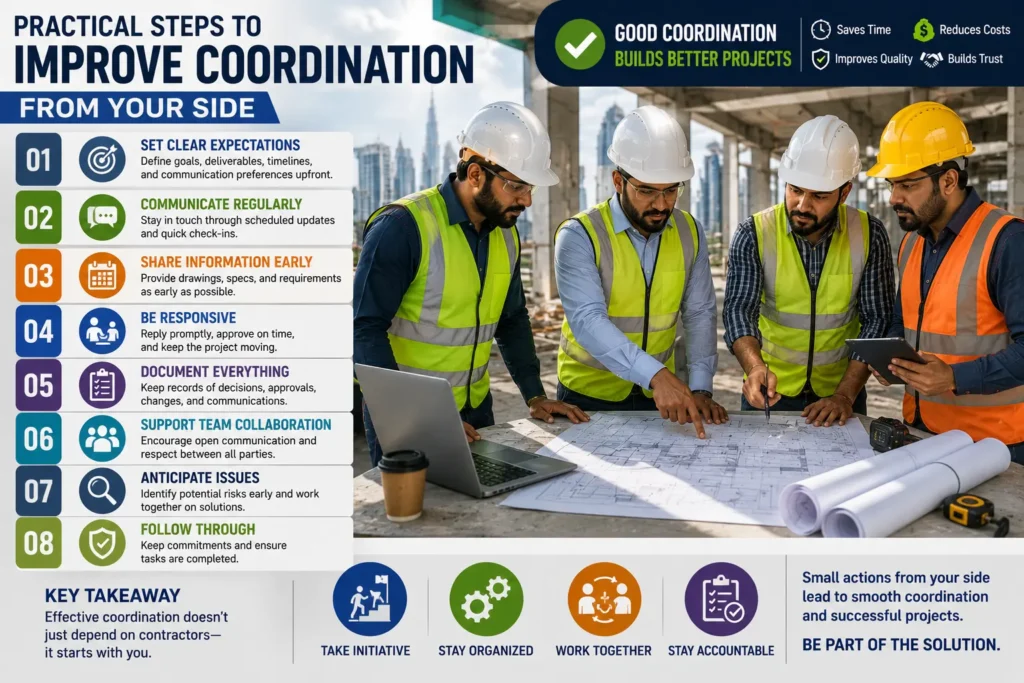
While much of the responsibility falls on the contractor, property owners and project managers can also take steps to support smoother coordination.
• Share a clear project timeline upfront, including dependencies between different trades.
• Designate a single point of contact to reduce miscommunication between multiple stakeholders.
• Confirm site access arrangements clearly before each scheduled visit.
• Request regular progress updates rather than waiting until the end of each phase.
Taking these steps helps create an environment where even a well coordinated contractor can perform at their best throughout the project.
Frequently Asked Questions
Why does coordination matter more on larger projects?
Larger projects involve multiple trades working on overlapping timelines, so poor coordination in one area can cause delays that affect the entire project schedule.
How can I tell if a contractor communicates well during projects?
Ask about their process for providing updates and handling unexpected delays, and request references from clients who managed similar multi trade projects.
Is it better to use the same contractor across all project phases?
Generally yes, since consistency improves familiarity with the site and reduces the need to repeat information with a new team each phase.
What happens if a cutting contractor discovers something affecting another trade?
An experienced contractor should communicate this immediately to the project manager and affected trades rather than waiting until the issue causes a delay.
Should I ask for references specific to multi trade projects?
Yes, references from similar complex projects give better insight into how a contractor handles coordination compared to references from simple, single trade work.
How do scheduling conflicts typically get resolved on larger sites?
Strong contractors flag potential conflicts early and work directly with the project manager to adjust timing before it affects other trades.
Does strong coordination cost more than working with less organized contractors?
It can, though the reduced risk of costly delays often makes it a better overall value for complex, multi trade projects.
What is the biggest coordination mistake to watch for?
A contractor who only communicates reactively, after a problem has already caused a delay, rather than proactively flagging potential issues in advance.
Conclusion
On complex projects involving multiple trades, technical cutting skill alone is not enough. Strong communication, proactive coordination, and consistency across project phases are just as important when selecting a contractor for demanding, multi trade work.
Taking the time to evaluate coordination style, not just cutting expertise, helps ensure your project moves forward smoothly rather than becoming bogged down by avoidable scheduling conflicts.
Call to Action

Ready to work with a team that understands complex project coordination as well as precise cutting work. Reach out today to discuss your project and scheduling requirements.
Phone and WhatsApp: +971 56 436 5457
Email: sccdubaiuae@gmail.com
Website: corecuttingdubaiuae.com
Free site visit and competitive quote for every core cutting project across Dubai and the UAE.