
Concrete Floor Saw Cutting in Dubai Expert Slab and Surface Cutting Services

Concrete floors are designed to provide strength, durability, and long term performance. However, construction and renovation projects often require sections of these surfaces to be cut, modified, or removed. Installing drainage systems, electrical conduits, plumbing lines, expansion joints, and underground utilities may require controlled cutting through an existing concrete floor. This is where professional Concrete Floor Saw Cutting becomes an important construction solution.
Unlike uncontrolled concrete breaking, floor saw cutting allows contractors to create predetermined cutting lines with greater accuracy. Specialized floor saw machines use diamond blades that can cut through concrete, reinforced concrete, asphalt, and other hard surfaces. The controlled process helps contractors remove only the required section while reducing unnecessary damage to surrounding areas.
In Dubai, where residential developments, commercial properties, industrial facilities, roads, warehouses, and infrastructure projects are constantly being constructed and renovated, accurate concrete cutting plays an important role in maintaining construction efficiency. Professional floor cutting can help contractors complete utility installations, repairs, structural modifications, and controlled removal work more efficiently.
Core Cutting Dubai UAE provides a range of professional concrete cutting solutions in Dubai, including floor saw cutting, slab sawing, core drilling, wall sawing, beam cutting, lift cutting, AC duct cutting, window cutting, and demolition work. The company’s listed floor saw service focuses on cutting plane and floor surfaces using concrete floor saw equipment.
This guide explains the purpose of floor saw cutting, how the process works, its applications, equipment options, benefits, safety requirements, and important factors to consider before starting a concrete cutting project.https://concretecontractordubai.com/
What Is Concrete Floor Saw Cutting?
Concrete Floor Saw Cutting is a specialized method used to create controlled cuts through horizontal surfaces such as concrete floors, slabs, roads, pavements, and other flat construction surfaces.
A professional floor saw normally consists of a heavy duty machine fitted with a diamond cutting blade. The operator guides the machine along a predetermined cutting line while the rotating blade gradually penetrates the concrete.
The process can be used for both shallow and deeper cutting applications depending on the machine, blade diameter, concrete thickness, and project requirements.
Common reasons for floor saw cutting include:
- Creating utility trenches
- Installing drainage systems
- Cutting expansion joints
- Removing damaged concrete
- Creating access sections
- Modifying concrete slabs
- Installing electrical services
- Installing plumbing systems
- Preparing surfaces for construction
- Cutting road and pavement sections
The main advantage is control. Instead of breaking an entire area, contractors can define exactly where the concrete should be separated.
Why Professional Floor Saw Cutting Matters
Concrete is strong enough to support buildings, vehicles, machinery, and heavy loads. This strength also makes it difficult to modify without specialized equipment.
Using inappropriate tools can result in:
- Uneven cuts
- Excessive vibration
- Unnecessary cracking
- Difficult concrete removal
- Additional repair work
- Increased project time
Professional Concrete Floor Saw Cutting provides a more controlled approach.
A properly planned cutting operation allows contractors to determine the required:
- Cutting location
- Cutting length
- Cutting depth
- Cutting width
- Removal area
This level of control is particularly valuable when working around existing structures and utility systems.
Main Applications of Concrete Floor Saw Cutting
Floor saw cutting can be used for a wide range of construction and maintenance applications.
Utility Trench Cutting
One of the most common applications is creating trenches for underground utilities.
Contractors may need floor cutting for:
- Electrical conduits
- Water pipes
- Drainage pipes
- Communication cables
- Mechanical services
Once the required channel has been cut, the concrete section can be removed and the utility installation can proceed.
Drainage Installation
Commercial kitchens, warehouses, industrial facilities, parking areas, and other properties may require new drainage routes.
Floor saw cutting allows contractors to create controlled channels for drainage installation without unnecessarily damaging the surrounding floor.
Expansion Joint Cutting
Concrete surfaces may require joints to accommodate movement and reduce the possibility of uncontrolled cracking.
Professional saw cutting can create predetermined joint lines according to project requirements.
Concrete Repair
Damaged sections of concrete sometimes need to be isolated before removal.
Controlled cutting can separate the affected section from the surrounding material, making repair work more organized.
Road and Pavement Cutting
Floor saw equipment can also be used on concrete roads and asphalt surfaces.
Typical applications include:
- Utility access
- Road repairs
- Drainage work
- Pavement modifications
- Infrastructure maintenance
Core Cutting Dubai UAE specifically lists floor saw cutting for concrete or asphalt surfaces used for repairs, expansion joints, and utility installations.
Industrial Floor Modification
Factories and warehouses often require modifications to existing floors for machinery, equipment foundations, drainage, and utility installations.
Professional cutting allows contractors to modify selected sections while keeping the remaining surface intact.
How the Floor Saw Cutting Process Works
A professional project normally follows several important stages.
Step One: Site Assessment
Before equipment is brought into operation, technicians inspect the project location.
They assess:
- Concrete thickness
- Surface condition
- Reinforcement
- Existing utilities
- Required cutting depth
- Accessibility
- Equipment requirements
- Project drawings
This information helps determine the most appropriate cutting method.
Step Two: Marking the Cutting Lines
The required cutting area is measured and marked carefully.
Accurate markings help the operator follow the correct route and prevent unnecessary cutting.
The marked layout should clearly identify:
- Starting point
- Ending point
- Cutting direction
- Required dimensions
- Sections that need removal
Step Three: Selecting the Blade
Diamond blades are selected according to the material and cutting requirements.
Factors can include:
- Concrete strength
- Aggregate type
- Reinforcement
- Cutting depth
- Required cutting speed
- Surface condition
The correct blade helps maintain cutting performance and reduces unnecessary equipment wear.
Step Four: Equipment Preparation
The floor saw is positioned along the marked line.
Before operation, technicians inspect the machine and ensure the blade is securely installed.
The cutting depth is then adjusted according to project specifications.
Step Five: Controlled Cutting
The operator gradually moves the machine along the marked path.
During cutting, the operator monitors:
- Machine alignment
- Cutting depth
- Blade performance
- Cutting speed
- Cooling requirements
- Surface condition
Maintaining controlled movement helps achieve a cleaner and more consistent result.
Step Six: Concrete Removal
Once the required cuts are completed, the isolated concrete section can be removed.
Depending on the size and weight of the section, suitable equipment may be used for lifting and removal.
This approach provides much better control than randomly breaking the entire surface.
Types of Floor Saw Equipment

Different projects require different types of floor cutting equipment.
Walk Behind Floor Saw
Walk behind machines are guided manually by the operator.
They are commonly suitable for:
- Small construction projects
- Medium floor cutting projects
- Utility trenches
- Pavement repairs
- Concrete slab modification
Self Propelled Floor Saw
Self propelled machines reduce the physical effort required from the operator and can be useful for larger cutting projects.
They are particularly helpful when long cutting distances or deeper cuts are required.
Electric Floor Saw
Electric equipment can be suitable for certain indoor projects where controlled operation and reduced emissions are important.
Potential applications include:
- Warehouses
- Parking structures
- Commercial buildings
- Renovation projects
Fuel Powered Floor Saw
Fuel powered equipment can provide greater mobility for outdoor projects where access to electrical power is limited.
The appropriate machine should always be selected according to the concrete thickness, cutting depth, site environment, and project requirements.
Important Factors Before Starting Floor Saw Cutting
Several factors should be considered before beginning a project.
Concrete Thickness
The thickness of the concrete determines the equipment and blade capacity required.
Reinforcement
Reinforced concrete may require specialized diamond blades and suitable cutting equipment.
Cutting Depth
The required depth should be established before work begins.
Existing Utilities
Electrical cables, plumbing lines, communication systems, and other hidden services should be identified wherever applicable.
Site Accessibility
The contractor needs enough space to transport, position, and operate the floor saw safely.
Concrete Removal
The project plan should also consider how the cut sections will be lifted, transported, and disposed of.
Benefits of Professional Floor Saw Cutting
Precise Cutting
Professional diamond cutting equipment provides controlled and accurate cutting lines.
Reduced Unnecessary Removal
Only the required sections can be separated, reducing unnecessary concrete removal.
Efficient Construction
Professional equipment allows contractors to complete many cutting applications efficiently.
Cleaner Results
Controlled sawing creates defined edges that are easier to work with during subsequent construction.
Suitable for Large Projects
Floor saw cutting can be adapted for residential, commercial, industrial, and infrastructure applications.
Why Choose Professional Specialists
A professional concrete cutting contractor brings more than just machinery to a project.
Experienced specialists understand how to:
- Assess the work area
- Select appropriate equipment
- Choose suitable diamond blades
- Mark cutting lines
- Control cutting depth
- Manage dust and slurry
- Protect nearby areas
- Remove cut concrete safely
This experience can help reduce delays and prevent avoidable mistakes.
Factors That Affect Floor Saw Cutting
Every concrete floor cutting project is different. The cutting speed, equipment requirements, and final result can change depending on several conditions.
Concrete Strength
The strength and age of the concrete can affect cutting performance. Older or high strength concrete may require specialized diamond blades and more powerful equipment.
Aggregate Type
Concrete contains different types of aggregate. Hard aggregates can increase blade wear and may require a suitable diamond blade specification.
Reinforcement
Reinforced concrete contains steel bars or mesh. When the blade encounters reinforcement, cutting performance can change, so the contractor needs to select suitable equipment and cutting methods.
Cutting Depth
A shallow surface cut requires different equipment considerations from a deep structural cut. The required depth should be established before the project begins.
Access Conditions
The available working space can affect machine selection. Narrow or restricted areas may require equipment that can be safely positioned and operated within the available space.
Project Schedule
Commercial and industrial projects often operate according to strict schedules. Professional equipment and experienced operators can help contractors complete cutting work efficiently.
Wet Cutting and Dry Cutting

Concrete floor cutting can generally involve wet or dry cutting methods depending on the project and equipment.
Wet Cutting
Wet cutting uses water during the cutting operation.
The water can help:
- Cool the diamond blade
- Control dust
- Improve cutting conditions
- Reduce airborne particles
- Support continuous cutting
However, water creates slurry that must be properly collected and managed.
Dry Cutting
Dry cutting does not use water during the cutting process.
It can be useful in situations where water could damage surrounding materials or where water management is impractical.
However, dust control becomes particularly important when dry cutting concrete.
The appropriate method depends on the site environment, material, equipment, and project requirements.
Concrete Floor Saw Cutting for Renovation Projects
Renovation work frequently requires modifications to existing concrete surfaces.
For example, a commercial property may need new drainage lines after a kitchen renovation. A warehouse may require additional electrical routes for new machinery. An older building may need floor modifications to accommodate updated plumbing or mechanical systems.
In these situations, controlled Concrete Floor Saw Cutting can help contractors create the required access while limiting unnecessary damage to the surrounding floor.
This is especially valuable when the existing structure needs to remain operational during renovation.
Floor Saw Cutting for Utility Installation
Modern buildings require extensive utility networks.
Electrical systems, plumbing, drainage, communication systems, and mechanical services may need to pass beneath or through existing concrete surfaces.
Floor saw cutting can provide a controlled method for preparing these routes.
Typical applications include:
- Electrical conduit installation
- Water supply lines
- Drainage pipes
- Communication cables
- Mechanical services
- Underground utility routes
The cutting layout should always be coordinated with the relevant construction drawings and utility plans.
Floor Saw Cutting for Concrete Removal
Sometimes a complete floor does not need to be removed.
Only a damaged, outdated, or obstructing section may need to be taken out.
In such situations, technicians can use controlled cuts to define the section that needs removal.
This can provide several benefits:
- Easier removal
- Better control
- Reduced unnecessary demolition
- Cleaner edges
- More organized construction
Core Cutting Dubai UAE also provides demolition work alongside floor saw cutting, slab sawing, wall sawing, core drilling, and other concrete services.
Difference Between Floor Saw Cutting and Slab Sawing
The terms floor saw cutting and slab sawing are often used in similar construction applications because both involve cutting horizontal concrete surfaces.
However, the exact equipment and technique can vary according to the project.
| Factor | Floor Saw Cutting | Slab Sawing |
|---|---|---|
| Surface | Horizontal concrete or asphalt | Concrete slabs and horizontal surfaces |
| Main purpose | Repairs, joints, utilities, removal | Slab modification and construction |
| Equipment | Floor saw with diamond blade | Specialized slab cutting equipment |
| Accuracy | High | High |
| Common projects | Roads, floors, utilities | Building slabs and structural projects |
The contractor should evaluate the specific project before selecting the appropriate cutting method.
How to Prepare a Site for Floor Saw Cutting
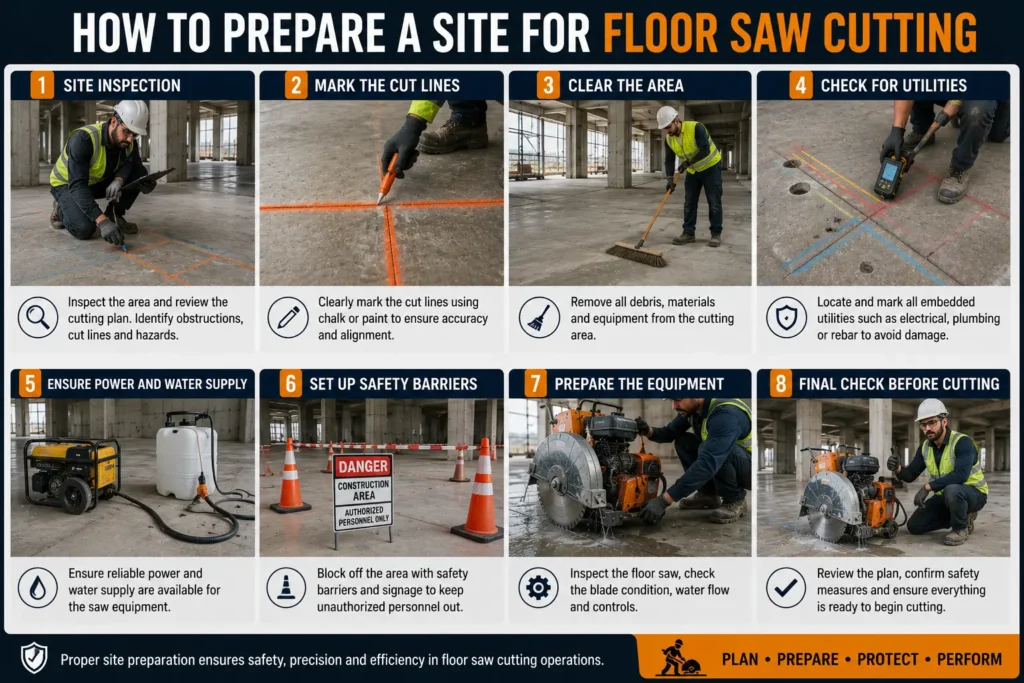
Proper site preparation can make the cutting operation safer and more efficient.
Clear the Work Area
Remove unnecessary materials, tools, equipment, and obstacles from the cutting zone.
Mark the Cutting Layout
Clearly mark the beginning, ending, and direction of every required cut.
Identify Existing Services
Check for concealed electrical, plumbing, communication, and mechanical systems before cutting where applicable.
Arrange Access
Ensure the cutting machine can reach the required area without unnecessary obstacles.
Plan Water Management
If wet cutting is selected, determine how water and slurry will be contained and removed.
Establish a Safety Zone
Keep unauthorized personnel away from the operating equipment.
Proper preparation helps reduce delays and allows technicians to concentrate on achieving accurate results.
Safety Measures for Concrete Floor Saw Cutting
Safety should be considered before, during, and after the cutting operation.
Professional technicians should use suitable personal protective equipment, including:
- Safety helmet
- Eye protection
- Hearing protection
- Protective gloves
- Appropriate safety footwear
- Suitable respiratory protection where required
The equipment should also be inspected before operation.
Important checks include:
- Diamond blade condition
- Blade attachment
- Machine controls
- Power supply
- Water connections where applicable
- Guards and safety features
The cutting area should remain controlled throughout the project.
Common Mistakes to Avoid
Starting Without a Cutting Plan
Cutting without a clear layout can result in incorrect dimensions and unnecessary material removal.
Ignoring Structural Requirements
Not every concrete surface should be cut without considering its structural role. Engineering requirements should be reviewed before modifying important structural elements.
Failing to Check Utilities
Hidden cables and pipes can create serious risks if they are not identified before cutting.
Using the Wrong Machine
The equipment should match the concrete thickness, cutting depth, access conditions, and project requirements.
Selecting an Unsuitable Blade
Diamond blades should be selected according to the material and application.
Poor Slurry Management
Wet cutting without proper water and slurry control can create slippery working conditions and additional cleanup requirements.
Why Professional Equipment Matters
Professional Concrete Floor Saw Cutting depends heavily on the equipment used.
Modern floor saws are designed to provide controlled movement and stable cutting performance.
A suitable machine can help provide:
- Consistent cutting depth
- Straight cutting lines
- Better operator control
- Efficient concrete penetration
- Reduced unnecessary vibration
- Improved productivity
Diamond blades are equally important because they are responsible for cutting through hard construction materials.
The right combination of machine and blade can significantly influence the quality of the finished cut.
Why Choose Core Cutting Dubai UAE
Core Cutting Dubai UAE provides professional concrete cutting and controlled demolition solutions in Dubai.
The company’s listed services include:
- Floor saw cutting
- Slab sawing
- Core drilling
- Wall sawing
- Beam cutting
- Lift cutting
- AC duct cutting
- Window cutting
- Demolition work
Its floor saw cutting service is specifically presented as a solution for cutting concrete or asphalt surfaces for repairs, expansion joints, and utility installations.
For contractors and property owners, having access to multiple concrete cutting services can simplify project coordination because different cutting requirements can be handled by an experienced specialist.
Frequently Asked Questions
What is Concrete Floor Saw Cutting used for?
It is used for cutting concrete floors, slabs, roads, and pavements for utility installation, repairs, expansion joints, controlled removal, and construction modifications.
Can floor saws cut reinforced concrete?
Yes. Appropriate floor saw equipment and diamond blades can be used for reinforced concrete depending on the thickness, reinforcement, and project requirements.
How deep can a concrete floor saw cut?
The maximum cutting depth depends on the machine, blade diameter, material thickness, and equipment specifications.
Is floor saw cutting suitable for asphalt?
Yes. Specialized equipment and suitable diamond blades can be used for certain asphalt cutting applications.
Does concrete floor cutting create dust?
Yes, particularly when dry cutting is used. Wet cutting and suitable dust control methods can help reduce airborne particles.
Is wet cutting better than dry cutting?
Neither method is universally better. The appropriate option depends on the project environment, material, equipment, water availability, and dust control requirements.
Can floor saw cutting be used for drainage installation?
Yes. Controlled floor cutting can create defined routes for drainage systems and other underground utilities.
Can floor saw cutting damage surrounding concrete?
Professional controlled cutting is designed to limit unnecessary damage. Proper equipment selection and experienced operation are important.
How long does floor saw cutting take?
The duration depends on the length, depth, concrete strength, reinforcement, equipment, site access, and overall project size.
Why should I hire a professional concrete cutting company?
A professional company has trained operators, suitable equipment, diamond blades, safety procedures, and experience handling different concrete conditions.
Conclusion
Concrete Floor Saw Cutting is an efficient solution for modifying concrete floors, slabs, roads, pavements, and other horizontal surfaces. It provides contractors with a controlled method for creating utility trenches, drainage routes, expansion joints, repair sections, and areas requiring concrete removal.
For projects in Dubai, Core Cutting Dubai UAE provides floor saw cutting as part of its wider concrete cutting and demolition services. Its service range includes floor saw cutting, slab sawing, wall sawing, core drilling, beam cutting, lift cutting, AC duct cutting, window cutting, and demolition work.
Whether the requirement involves a residential renovation, commercial property, industrial facility, road project, utility installation, or concrete repair, professional floor saw cutting can provide the accuracy and control required for quality construction work.
Contact Core Cutting Dubai UAE

If you need professional Concrete Floor Saw Cutting in Dubai, discuss your project requirements with Core Cutting Dubai UAE before starting the work.
Providing details such as the concrete thickness, required cutting depth, cutting length, project location, and purpose of the cutting can help determine the appropriate equipment and method.
Professional planning at the beginning can save time, reduce unnecessary damage, and help your construction project progress smoothly.