
Best Saw for Cutting Wet Wall Expert Guide and Professional Cutting Services by Core Cutting Dubai UAE

If you are working on a construction or renovation project in Dubai and need to cut through a concrete wall using water as part of the process, the first question you need to answer is straightforward what is the best saw for cutting wet wall? The answer depends on the type of opening you need, the wall material and thickness, and the level of reinforcement inside the concrete. At Core Cutting Dubai UAE, wet wall cutting is something our team does every day across residential, commercial, and industrial projects throughout the emirate. This guide shares everything you need to know to make the right equipment decision and understand why professional wet cutting always delivers results that amateur methods cannot.
Whether you need to understand the options before hiring a contractor or you are a professional looking to confirm the right approach for a specific project, this complete guide covers every aspect of the best saw for cutting wet wall in Dubai construction.
Table of Contents
- Understanding Wet Wall Cutting in Dubai Construction
- The Role of Water in Concrete Wall Cutting
- Best Saws for Cutting Wet Wall — Complete Comparison
- Diamond Blade Selection Guide for Wet Wall Cutting
- Best Saw Choice by Wall Type Found in Dubai Buildings
- Critical Mistakes to Avoid When Cutting Wet Walls
- Site Safety for Wet Wall Cutting Operations in Dubai
- Why Professional Wet Wall Cutting Always Wins Over DIY
- Our Wet Wall Cutting Services Across Dubai
- Frequently Asked Questions
- Conclusion
Understanding Wet Wall Cutting in Dubai Construction
The term wet wall cutting covers two distinct but related situations in Dubai construction work. The first is cutting through walls that are physically wet recently poured green concrete, moisture-laden basement walls, bathroom and kitchen walls with ongoing water exposure, or walls in areas where water ingress is present. The second and more technically precise meaning is cutting concrete walls using the wet cutting method that is, applying a continuous water supply to the blade or drill bit throughout the cutting operation regardless of whether the wall itself contains moisture.
In Dubai’s professional construction environment, wet cutting is not optional. It is the required standard for all concrete wall cutting using diamond blades. The reasons for this are practical and safety-related in equal measure. Wet cutting extends blade life, improves cut quality, reduces dust to manageable levels, and keeps the cutting operation under better control from start to finish. The best saw for cutting wet wall is therefore always a saw that is specifically designed and properly equipped to deliver continuous, controlled wet cutting throughout the entire duration of the cut.
Green Concrete Versus Cured Concrete Wet Wall Cutting
Green concrete concrete that has been placed but not yet fully cured presents specific challenges for wet wall cutting. It is softer and more abrasive than fully cured concrete, which means it wears through diamond blade bond matrices faster and requires a harder bond blade specification than the same concrete at full cure strength. Fully cured concrete is harder and denser, requiring a softer bond blade that exposes fresh cutting diamonds more readily to maintain cutting speed. Understanding this distinction and selecting the correct blade specification for the curing stage of the concrete being cut is part of what makes professional wet wall cutting different from amateur attempts.
Why the Best Saw for Cutting Wet Wall Must Have Reliable Water Delivery
Every saw used for wet wall cutting must be able to deliver water reliably and consistently to the blade or drill bit throughout the entire cutting operation. Intermittent water supply water that stops and starts, that drips rather than flows, or that is applied manually by an assistant rather than through the saw’s integrated system produces inconsistent results. The blade temperature rises during the gaps in water supply, diamond segment performance degrades, and cut quality suffers. The best saw for cutting wet wall integrates water delivery as a core part of the system rather than an afterthought.
The Role of Water in Concrete Wall Cutting
Water plays three distinct and essential roles during professional concrete wall cutting. Understanding these roles explains why the continuous water supply requirement is non negotiable in any professional wet wall cutting operation in Dubai.
Thermal Management of the Diamond Blade
Friction between the rotating diamond blade and the concrete surface generates heat at the cutting interface that builds up rapidly during operation. Diamond segments in a wet cutting blade are held in place by a bond matrix typically a metallic powder sintered around the diamond particles. When this bond matrix overheats, it softens and loses its ability to hold the diamonds in place. The diamonds are then released from the segment before completing their cutting life, a failure mode called premature diamond pull out. The result is a blade that cuts slowly and unpredictably and must be replaced far earlier than its designed service life.
Water delivered to the blade at the cutting interface absorbs heat continuously and carries it away from the cutting zone, keeping the bond matrix within its designed operating temperature range throughout the full cutting operation. Consistent thermal management is what allows a diamond blade to maintain its cutting performance from the first millimeter of cut to the last and the best saw for cutting wet wall always delivers this thermal management reliably.
Concrete Dust Suppression at the Point of Generation
Cutting concrete walls generates fine silica particles that are extremely hazardous to human health when inhaled. Silica dust exposure is the primary occupational health risk in concrete cutting work and is directly regulated by UAE health and safety requirements. Water applied at the cutting face combines with these particles as they are generated, turning them into a wet slurry that falls to the floor rather than becoming airborne dust that workers and building occupants breathe.
Wet cutting reduces airborne silica dust levels by up to ninety percent compared to dry cutting. For any professional concrete wall cutting operation on a Dubai construction site occupied or unoccupied this level of dust suppression is both a health requirement and a regulatory standard that must be met.
Cutting Face Maintenance and Slurry Removal
As the diamond blade grinds through concrete, the particles ground off mix with water and form a concrete slurry in the cut kerf. This slurry must be continuously removed from the cutting face to maintain cutting efficiency. If slurry is allowed to accumulate in the kerf, it increases the resistance against the blade, generates additional heat, and reduces the cutting rate. The water flow through the wet cutting system provides the hydraulic force needed to continuously flush slurry from the kerf, keeping the diamond segments in direct contact with fresh concrete throughout the cut rather than grinding repeatedly through already-ground material.
Best Saws for Cutting Wet Wall Complete Comparison
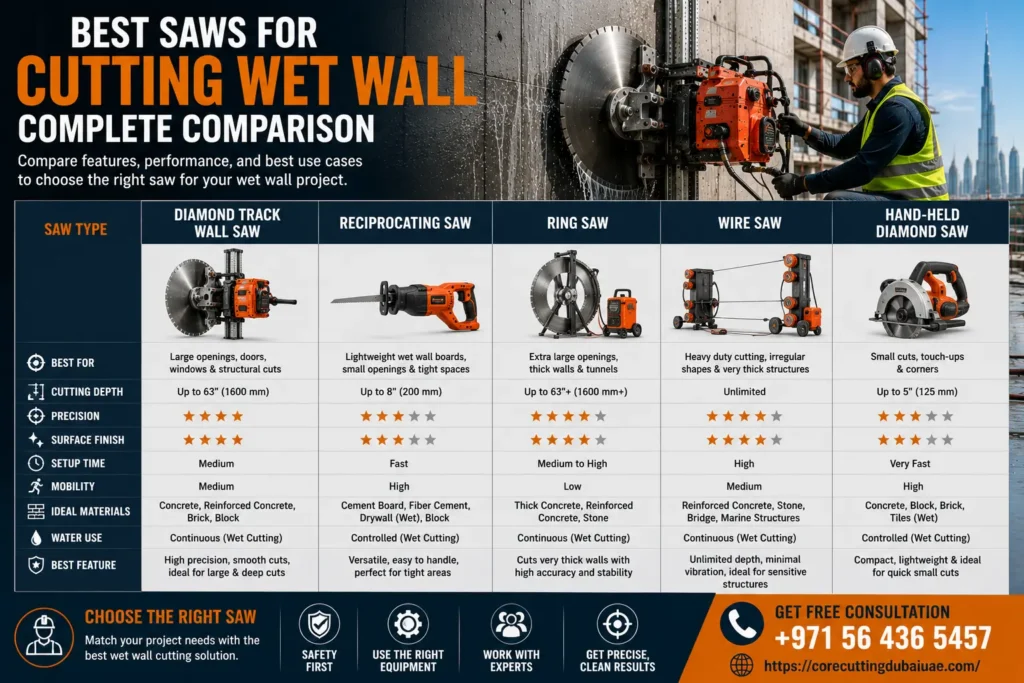
Several different types of saw are used for cutting concrete walls professionally in Dubai. Each type has specific strengths that make it the best saw for cutting wet wall in particular applications. Understanding each option allows you to confirm that the right equipment is being specified for your specific project requirement.
Track Mounted Diamond Wall Saw
The track-mounted diamond wall saw is the best saw for cutting wet wall when the requirement is a rectangular or square opening in a concrete wall. Our wall sawing service uses this equipment as the primary tool for all door openings, window openings, large duct penetrations, access openings, and any other application where straight, clean edges are required on a rectangular opening.
Track System and Guided Accuracy
The defining feature of the track-mounted wall saw is its steel rail guidance system. This rail is anchored directly to the wall surface and the saw motor unit travels along it under controlled power throughout the cut. The blade cannot deviate from the rail line regardless of what it encounters inside the wall concrete density variations, reinforcement bars, aggregate pockets because the blade is physically constrained to follow the track. This mechanical guidance is what delivers dimensional accuracy within two to three millimeters across the full length of any cut, something that no handheld saw can achieve on a concrete wall of any meaningful thickness.
Integrated Wet Cutting Water Supply
The track mounted wall saw integrates water delivery as part of the machine system. Water is supplied to the blade through channels in the blade guard and saw head, delivering a consistent flow directly to the cutting interface throughout the operation. This integrated water delivery is what makes the track mounted wall saw the best saw for cutting wet wall in rectangular opening applications the water supply cannot be accidentally interrupted and does not require a separate operator to manage.
Cutting Depth Range for Dubai Wall Thicknesses
Track-mounted wall saws used in Dubai professional work handle wall thicknesses from 100mm standard partition walls through to approximately 600mm in a single pass from one side. The cutting depth is determined by the blade diameter in use larger diameter blades deliver greater cutting depth. For walls above the single side cutting capability, our team cuts from both sides or switches to wire saw equipment to achieve the required full penetration.
Water Fed Diamond Core Drill
The water fed diamond core drill is the best saw for cutting wet wall when the requirement is a circular hole rather than a rectangular opening. Our core drilling service uses water fed diamond core drilling equipment for all pipe penetrations, electrical conduit routes, AC refrigerant line set holes, ventilation connections, and anchor bolt holes through concrete walls and slabs across Dubai.
How Water Fed Core Drilling Works
Water is fed through the hollow center of the core drill spindle and exits directly at the cutting interface between the diamond bit segments and the concrete. This central water delivery is more efficient than external water application because it delivers cooling and slurry flushing directly where the cutting is happening, regardless of the drilling angle or depth. This central feed design makes water fed core drilling particularly effective for walls that are genuinely wet from moisture or water ingress, as the established water flow through the system maintains consistent performance even when the concrete is already saturated.
Diamond Wire Saw for Thick and Complex Wet Wall Cutting
The diamond wire saw is the best saw for cutting wet wall in situations where neither the track mounted blade saw nor the core drill can achieve the required result. This applies to very thick concrete walls above the single side blade capacity, to walls in confined spaces where a track system cannot be physically installed, and to concrete elements of irregular cross-section that blade saws cannot access from a single position.
The wire saw uses a continuous loop of diamond embedded wire running around motorized pulleys that are anchored around the concrete element being cut. Water is applied to the wire throughout the cutting operation. The wire progressively cuts through the concrete structure by the combined action of diamond abrasion and the tension in the wire loop. This method can handle concrete elements of virtually any thickness and can access cutting positions that no other saw type can reach.
Floor Mounted Diamond Slab Saw for Horizontal Wet Cutting
When the cutting requirement involves a horizontal concrete surface rather than a vertical wall for drainage trenches, service penetration channels, expansion joints, or structural slab modifications our slab sawing and floor saw cutting services use floor-mounted diamond slab saws. These machines move across the floor surface on wheels with the diamond blade cutting vertically downward through the slab under gravity-assisted feed, with water delivered to the blade throughout the operation.
Handheld Diamond Angle Grinder When It Is and Is Not Appropriate
A handheld angle grinder fitted with a diamond blade can cut through concrete walls in limited circumstances for very shallow cuts, for edge dressing after primary cutting, or for making small adjustments to an existing opening. However, it is not the best saw for cutting wet wall for any primary wall opening application in Dubai professional work. It lacks track guidance so cut accuracy depends entirely on the operator. Most handheld grinders are not properly configured for wet cutting with consistent water delivery. And the small blade diameter severely limits the achievable cutting depth, making them impractical for walls of any meaningful thickness. Professional concrete wall cutting in Dubai always uses track-mounted or stand mounted equipment for primary cutting operations.
Diamond Blade Selection Guide for Wet Wall Cutting
Selecting the correct diamond blade is as important as selecting the correct saw. The best saw for cutting wet wall with the wrong blade produces poor results slow cutting, rough edges, premature blade wear, and potential motor damage. Our team selects the blade specification for every project based on the concrete characteristics confirmed during our pre cutting site assessment.
Bond Hardness and Its Effect on Wet Cutting Performance
The bond hardness of a diamond blade segment is the most important selection parameter for matching the blade to the concrete being cut. Bond hardness describes how quickly the matrix material holding the diamond particles wears away during cutting. In soft or medium concrete, a harder bond is used because the concrete is not abrasive enough to wear the bond at the rate needed to expose fresh diamonds. In hard or very hard concrete, a softer bond is used because the concrete is abrasive enough to wear the bond efficiently, continuously exposing fresh cutting diamonds at the segment face.
Getting this bond selection right in wet cutting is particularly important because water changes the cutting dynamics compared to dry cutting. The same concrete that behaves one way under dry cutting will behave somewhat differently under wet cutting because the water changes the abrasion and friction characteristics at the cutting interface. Our team accounts for this difference when selecting blade specifications for wet wall cutting projects.
Segment Height and Blade Life in Wet Cutting
The height of the diamond segment above the steel core disc of the blade determines how many total hours of cutting the blade can deliver before the segments are consumed down to the core. Taller segments provide longer blade life but cost more per blade. For wet wall cutting projects with large total cutting lengths, higher segment height blades reduce the number of blade changes required and maintain consistent cutting performance over longer operations without interruption.
Wet Cutting Blade Rating Versus Dry Cutting Blade Rating
Diamond blades are specifically manufactured and rated either for wet cutting or for dry cutting, and these two types should not be interchanged. Wet cutting blades have segment bond formulations that are optimized for performance with water present at the cutting interface. Using a dry cutting blade with water produces suboptimal results because the bond formulation is not designed to work correctly in the wet environment. Using a wet blade without water causes rapid overheating and premature segment failure because the blade depends on water for thermal management. The best saw for cutting wet wall always uses a blade that is correctly rated and designed for wet cutting operation.
Best Saw Choice by Wall Type Found in Dubai Buildings
Dubai’s building stock includes a wide variety of wall types and construction materials. The best saw for cutting wet wall varies in its specific configuration and blade specification depending on the wall material being cut.
Reinforced Concrete Structural Walls
Reinforced concrete walls the most structurally demanding wet wall cutting application in Dubai require a track mounted diamond wall saw with a blade specification matched to the concrete compressive strength and reinforcement bar density. The track guidance system is essential because reinforcement bars create varying resistance that would deflect a handheld blade from the intended cut line. A medium to soft bond blade with adequate diamond concentration handles standard structural concrete efficiently while maintaining performance through reinforcement zones.
Hollow and Solid Concrete Block Walls
Concrete block walls hollow and solid are the most common wall type across Dubai residential and commercial buildings. A track mounted wall saw with a harder bond blade handles these walls efficiently for rectangular openings. The hollow nature of hollow block walls means the blade alternates between cutting the solid block faces and passing through the hollow interior, which requires a blade bond that maintains performance through this alternating resistance without glazing during the low-resistance hollow sections.
AAC Aerated Lightweight Block Walls
Autoclaved aerated concrete blocks require a soft to medium bond blade because the material is soft and non abrasive a hard bond blade will glaze rapidly in AAC as the material does not wear the bond matrix at the rate needed to expose fresh diamonds. Wet cutting in AAC is particularly clean and fast with the correct blade, producing excellent edge quality with minimal dust even before water suppression takes full effect.
Double Skin and Cavity Wall Constructions
Double skin walls with a cavity between inner and outer concrete skins present a specific challenge for the best saw for cutting wet wall the blade must transition from cutting concrete, through an air cavity, and back into concrete. This transition changes the cutting resistance suddenly, which can cause blade deflection in handheld operation. The track-mounted system handles this transition without deviation because the blade is physically constrained to follow the track throughout the full cut depth.
Thick Industrial Concrete Perimeter Walls
Industrial facility perimeter walls in Dubai’s Al Quoz, Jebel Ali, and Dubai Investment Park areas can be 400mm to 600mm or more in thickness. For walls at the upper end of this range or above, our wire saw service is the best saw for cutting wet wall because it is not limited by blade diameter in the same way a circular saw is. Wire sawing delivers the full required cutting depth through thick industrial walls without the need for dual-side cutting setups.
Critical Mistakes to Avoid When Cutting Wet Walls

Understanding what goes wrong in wet wall cutting operations helps explain why professional equipment and trained operators are essential for any Dubai project where concrete walls need to be cut. These are the most significant errors our team sees when we are called in to correct problems created by inadequate initial cutting attempts.
Starting to Cut Without Scanning the Wall
Cutting into a concrete wall without first scanning for hidden services and reinforcement is the most dangerous mistake in wet wall cutting. A water pipe struck during a wet cutting operation immediately floods the cutting area with pressurized water a situation that is both dangerous and highly damaging. An electrical cable struck during cutting creates an electrical fault that can injure workers and damage the building’s electrical system. A gas line struck during any cutting operation is a life safety emergency. Our team scans every wall before any blade or bit is started no exceptions, on every project.
Inadequate Water Flow Rate to the Blade
Insufficient water flow to the blade during wet wall cutting causes the blade temperature to rise toward the damage threshold within minutes of starting the cut. The first sign is usually a reduction in cutting speed as the diamond segments begin to glaze. If cutting continues without restoring adequate water flow, permanent segment damage occurs and the blade requires replacement. Checking and confirming correct water flow rate before starting any wet cutting operation is a basic professional requirement that our team never skips.
Applying Water Incorrectly to the Blade
Water must be delivered directly to the blade at the cutting interface not poured on the wall surface above the cut or splashed on the blade from the side. Incorrect water application means the water reaches the blade after the heat is already building rather than at the point where heat is generated. The best saw for cutting wet wall delivers water through channels integrated into the saw head or blade guard so that water arrives at the cutting interface precisely where and when it is needed.
Cutting Structural Walls Without Engineering Approval
No matter what the best saw for cutting wet wall is and how skillfully it is operated, cutting into a structural or load-bearing concrete wall without engineer approval and proper structural assessment creates unacceptable risk. The consequences of cutting in the wrong position or to the wrong dimensions in a structural wall can include progressive cracking, load redistribution to unintended structural elements, and in serious cases partial structural failure. Our team never proceeds with structural wall cutting without confirmed engineering approval this requirement applies to every structural cutting project regardless of size or apparent simplicity.
Site Safety for Wet Wall Cutting Operations in Dubai
Wet wall cutting is a high risk construction activity in Dubai that requires proper safety management throughout every stage of the operation. Dubai’s construction safety regulations and site standards set clear requirements for how this work must be conducted.
Personal Protective Equipment Requirements
Every operator conducting wet wall cutting must wear properly specified personal protective equipment. Safety glasses or a full face shield protect against concrete fragments and slurry splash. Hearing protection manages the noise of the saw motor and blade contact with concrete. Heavy duty cut resistant gloves protect hands during blade changes and panel handling. Steel capped safety boots protect feet in the working area. Wet weather protective clothing manages the water environment created by continuous wet cutting operations.
Electrical Safety Around Water
Wet wall cutting creates a working environment where electrically powered equipment operates in close proximity to water. All electrical equipment must be properly earthed. All connections must be rated for wet use and protected against water ingress. GFCI (ground fault circuit interrupter) protection must be in use on every power circuit supplying cutting equipment during wet operations. These electrical safety requirements are not optional they are essential protections against electrocution risk that exists wherever powered equipment and water are present simultaneously.
Slurry Containment to Protect the Site
The concrete slurry produced by wet wall cutting must be properly contained and managed throughout the operation. Uncontrolled slurry runoff creates slip hazards for workers, blocks drainage systems, damages adjacent flooring and finishes, and leaves the site in an unacceptable condition. Our team brings plastic containment sheeting, collection trays, and wet vacuum equipment to every site. We set up containment before starting any cutting and manage the slurry throughout the operation so the site is left clean after every job.
Why Professional Wet Wall Cutting Always Wins Over DIY
Property owners and general contractors in Dubai sometimes consider handling wet wall cutting without specialist help. The comparison between what professional wet wall cutting delivers and what DIY attempts typically achieve makes the right decision clear.
Equipment Access and Quality Gap
The best saw for cutting wet wall in professional construction a track mounted hydraulic or electric wall saw with integrated water delivery is a specialist piece of equipment that is not accessible through standard tool rental channels in Dubai. It costs significantly more than general construction equipment and requires trained operators who understand its setup, operation, and maintenance. The tools that a non specialist contractor can access for concrete wall cutting are categorically inferior to professional wall saw equipment in every performance characteristic that matters cut accuracy, depth capability, blade life, water management, and operator safety.
The Real Cost of Poor Quality Wet Wall Cutting
A poorly executed wet wall cut in a Dubai building creates costs that far exceed the saving from not hiring a professional. Inaccurate cuts require remedial concrete work before frames can be fitted adding material cost, labour cost, and programme delay. Structural damage from uncontrolled cracking requires assessment by a structural engineer and potentially significant remediation work. Hidden service strikes from unscanned walls create flooding, electrical faults, or gas leaks that are expensive emergencies. None of these outcomes happen when the right professional team with the best saw for cutting wet wall handles the work correctly from the start.
Programme Efficiency of Professional Wet Wall Cutting
A professional wet wall cutting team with the right equipment completes a standard door opening in a 200mm reinforced concrete wall in two to three hours including full site cleanup. A non-specialist attempting the same opening with inadequate tools takes many times longer and still produces an inferior result that requires additional remediation work. On any Dubai construction project where programme matters and it always does professional wet wall cutting is faster and more programme efficient than any alternative approach.
Our Wet Wall Cutting Services Across Dubai
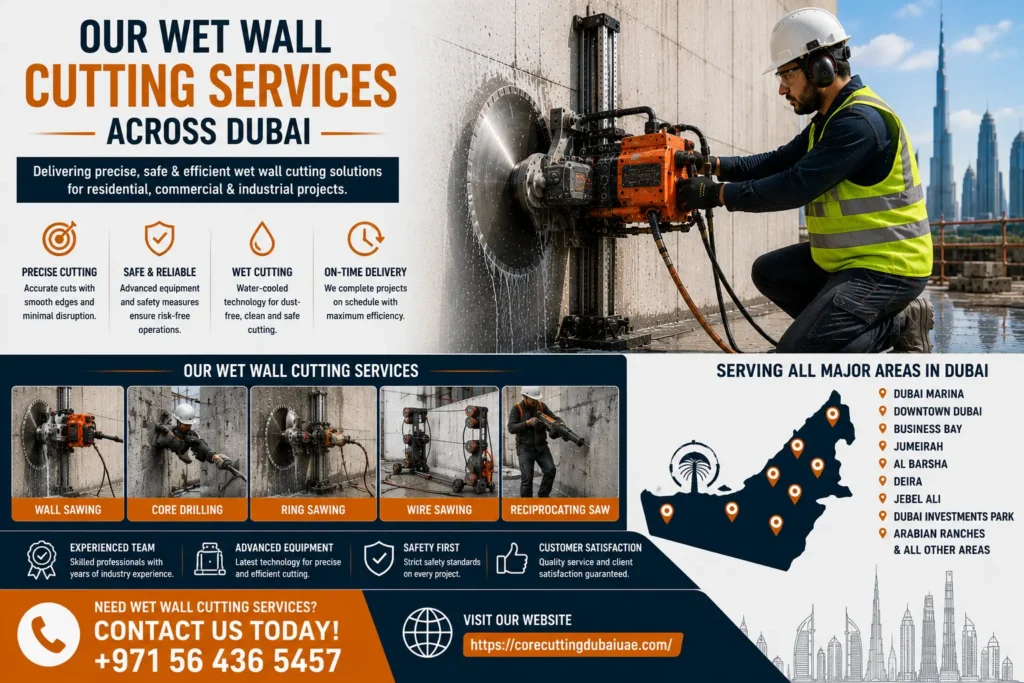
Core Cutting Dubai UAE provides the complete range of professional wet wall cutting services across all areas of Dubai. Our team uses the best saw for cutting wet wall matched to every specific application, with proper blade selection, integrated water management, and a structured process that delivers safe, accurate results on every project.
Wall Sawing Service
Our wall sawing service uses track-mounted diamond wall saws with integrated wet cutting water delivery to create precise rectangular openings in concrete walls for doors, windows, service duct penetrations, and structural openings across all project types and wall thicknesses in Dubai.
Core Drilling Service
Our core drilling service uses water-fed diamond core drilling equipment to create precise circular penetrations through concrete walls, floor slabs, and roof slabs for pipe installations, conduit routes, AC line sets, ventilation connections, and anchor bolt holes across Dubai.
Slab Sawing Service
Our slab sawing service delivers accurate wet diamond saw cuts through concrete floor and roof slabs for service penetration openings, drainage channel installation, and structural slab modifications in buildings across Dubai and the UAE.
Floor Saw Cutting Service
Our floor saw cutting service provides controlled wet diamond saw cuts through concrete floor surfaces and asphalt for expansion joints, service trenches, drainage channels, and road cutting work across Dubai construction and infrastructure projects.
AC Duct Cutting Service
Our AC duct cutting service creates precise wet-cut penetrations through concrete walls for air conditioning duct connections, refrigerant pipe sleeves, and ventilation installations across residential and commercial projects throughout Dubai.
Windows Cutting Service
Our windows cutting service creates accurate wet saw cut window openings in concrete and masonry walls for new window installations and window enlargement projects in residential and commercial buildings across Dubai.
Lift Cutting Service
Our lift cutting service provides specialist wet concrete cutting for lift shaft construction, elevator pit preparation, and lift opening modifications in residential and commercial buildings across Dubai where precise structural cutting is required.
Beam Cutting Service
Our beam cutting service provides precise wet diamond cutting for structural beam modifications, connection preparations, and beam end removals in renovation and structural modification projects across Dubai buildings.
Demolition Work Service
Our demolition work service provides controlled, safe removal of concrete walls, slabs, and structural elements using methods that combine wet cutting for boundary definition with controlled breaking for material removal, protecting all adjacent building components throughout every demolition scope.
Frequently Asked Questions About the Best Saw for Cutting Wet Wall
What is the best saw for cutting wet wall in concrete buildings in Dubai
The best saw for cutting wet wall for rectangular openings in concrete walls is the track-mounted diamond wall saw with integrated water supply. It combines fixed-track cut accuracy, diamond blade performance through reinforced concrete, and consistent wet cutting water management in one professional system. For circular holes through wet walls, the water-fed diamond core drill is the best tool. For very thick walls or confined access situations, the diamond wire saw is the best option. Core Cutting Dubai UAE uses all three systems and selects the correct one for each specific project requirement.
Can I use a regular saw with a wet blade to cut concrete walls in Dubai
A regular handheld saw even one fitted with a diamond wet cutting blade is not appropriate for professional concrete wall cutting in Dubai. Without a track guidance system, the blade cannot maintain a straight cut line through the resistance variations created by concrete aggregate and reinforcement. The cutting depth of handheld equipment is severely limited compared to track-mounted professional saws. And the water management systems on handheld equipment are inadequate for sustained professional wet wall cutting operations. Track-mounted professional wall saws should always be used for primary concrete wall cutting work.
Why does water have to be used continuously when cutting a wet wall
Water must be used continuously during wet wall cutting for three reasons. It cools the diamond blade segments continuously to prevent overheating and premature diamond release. It suppresses concrete silica dust at the point of generation before it becomes airborne, protecting worker health. And it flushes concrete slurry from the cutting face continuously, maintaining diamond cutting efficiency throughout the full depth and length of every cut. Intermittent or inadequate water supply during wet wall cutting degrades all three of these functions simultaneously and produces inferior results with a shorter blade life.
How do you prevent water damage to floors when using the best saw for cutting wet wall
Our team brings comprehensive water and slurry containment equipment to every wet wall cutting job. Before cutting begins, plastic sheeting is laid on all floors in the work area and collection trays are positioned to capture water and slurry flow from the cutting position. Wet vacuum equipment is used to manage accumulated water during the operation. After cutting is complete, the full work area is cleaned of all water, slurry, and debris before our team leaves the site. Floors and adjacent finishes are fully protected throughout every wet cutting operation we carry out.
What is the maximum depth a wall saw can cut when cutting a wet wall in Dubai
Our track-mounted wall saw equipment handles wet wall cutting depths from thin 100mm partition walls through to approximately 600mm thick walls in a single pass from one side. The exact achievable depth is determined by the blade diameter in use on the specific machine configuration. For walls thicker than the single-side capability, we cut from both sides of the wall or switch to our wire saw service to achieve the required full wall penetration. Every project is assessed individually and the cutting approach is confirmed during our free site visit before work begins.
Does Core Cutting Dubai UAE scan walls before wet wall cutting
Yes. Scanning the wall before any cutting begins is a mandatory step on every project we undertake. We scan at every intended cutting position to map reinforcement bar positions and detect any hidden services within the wall before any blade or drill bit is started. This scanning eliminates the risk of striking hidden water pipes, electrical cables, gas lines, or post-tensioning tendons during cutting. The scan results also directly inform our blade and bit selection for the specific reinforcement density present at each cutting location.
How long does wet wall cutting take on a typical Dubai project
A standard door opening through a 200mm reinforced concrete wall using a track mounted wall saw typically takes two to three hours from arriving on site to completing full cleanup. Window openings of comparable wall thickness take a similar duration. Core drilled holes through standard residential walls typically take five to fifteen minutes per hole depending on the diameter. For projects with multiple openings or holes, we provide a full time estimate as part of every project quotation after the site assessment.
Which areas of Dubai does Core Cutting Dubai UAE cover for wet wall cutting services
We cover all areas of Dubai for wet wall cutting services including Downtown Dubai, Business Bay, Dubai Marina, JBR, Palm Jumeirah, Jumeirah, Al Barsha, Al Quoz, Deira, Bur Dubai, DIFC, Mirdif, Dubai Silicon Oasis, Dubai Investment Park, Jebel Ali, Dubai South, Al Warqa, Ras Al Khor, Al Quoz Industrial, and all surrounding districts. We also provide wet wall cutting services across Sharjah, Ajman, Abu Dhabi, and other Emirates for qualifying projects.https://concretecontractordubai.com/
Conclusion
The best saw for cutting wet wall is never one single answer that applies to every situation. It is the track-mounted diamond wall saw for rectangular openings, the water fed diamond core drill for circular penetrations, and the diamond wire saw for the most demanding thick-wall and confined-access applications. What these three tools share is the use of diamond cutting technology with continuous controlled water delivery the two characteristics that define professional wet wall cutting and separate it from every inferior alternative.
At Core Cutting Dubai UAE, our team uses all three of these professional wet cutting systems across hundreds of projects in Dubai every year. We select the best saw for cutting wet wall for every specific application, with properly matched blade specifications, correct water delivery setup, mandatory pre cut wall scanning, and a structured safe delivery process that protects your building and delivers results your project can build on.
If you have a concrete wall in Dubai that needs to be cut wet or dry, thin or thick, residential or industrial contact Core Cutting Dubai UAE today for a fast response, free site visit, and competitive quotation.
Contact Core Cutting Dubai UAE for Professional Wet Wall Cutting

Phone and WhatsApp: +971 56 436 5457
Email: sccdubaiuae@gmail.com
Website: corecuttingdubaiuae.com/contact-us
Free site visit and competitive quote for every wet wall cutting project across Dubai and UAE.